『Ramayana』のカバーアート

Ramayana

Ramayana

著者: Jyotish QB
無料で聴く

The Shrimad Valmiki Ramayana, is revered as the world's first epic (Adi Kavya), composed by Maharshi Valmiki, the "Adi Kavi" [History]. This foundational text of Indian spirituality is considered a "National Treasure" that manifests the Vedas through the life of Shri Rama, who is depicted as the embodiment of Dharma and an incarnation of the Supreme Reality . Consisting of 24,000 verses organized into seven major books (Kandas), the epic provides an eternal template for moral conduct, mapping a path of righteousness that explores themes of truthJyotish QB スピリチュアリティ ヒンズー教
エピソード
  • Sunderkand- The heroic Odyssey of Hanuman
    2026/07/03

    Hanuman's heroic odyssey to Lanka begins with him expanding his form to a mountain-like size on Mount Mahendra and leaping across the hundred-yोजन wide ocean to restore Dharma by finding Sita. During his flight, he successfully navigates celestial trials, including declining the rest offered by the golden mountain Mainaka, outwitting the nagamata Surasa by entering and exiting her massive mouth, and slaying the shadow-grabbing demoness Simhika from within. To infiltrate the heavily guarded city of Lanka, he reduces his size to that of a small cat and defeats the city's guardian deity, Lanka, who then recognizes the signs of Ravana's impending doom. Hanuman meticulously searches through Ravana's opulent palaces and the magnificent Pushpaka Vimana, briefly mistaking the sleeping Mandodari for Sita before realizing a woman of Sita's virtue would not be resting in such luxury. He finally discovers a grief-stricken and emaciated Sita under a Shansapa tree in the Ashoka Vatika, where she is surrounded by terrifying demonesses. From his hiding place in the tree, he narrates Rama's life story to win her confidence and eventually presents Rama's signet ring, providing her with the first ray of hope since her abduction. Before concluding his visit, he reassures her of Rama's imminent rescue, receives her Chudamani (crest-jewel) as a token of recognition, and proceeds to demonstrate his divine power by destroying Ravana's grove and slaying his forces, including Aksha Kumara.

    続きを読む 一部表示
    37 分
  • Prelude to Avatar of Shri Ram
    2026/07/03

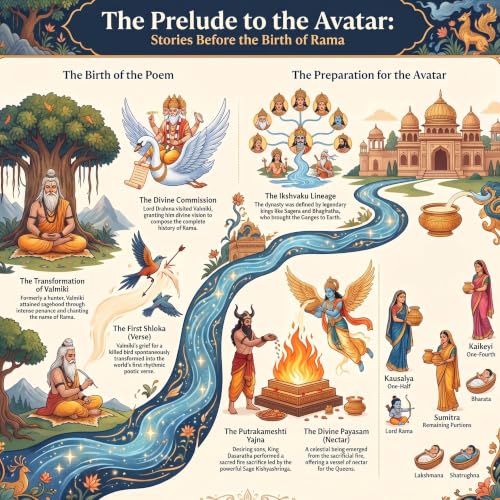
    The prelude to the incarnation of Shri Rama is an intricate cosmic arrangement designed to restore Dharma and resolve a "cosmic loophole" created by the hubris of the demon-king Ravana. According to the sources, the narrative foundation is rooted in the ascendancy of Ravana, the ten-headed son of Sage Vishrava, who performed intense penance to receive a boon of invincibility from Lord Brahma [110, History Audio]. In his extreme arrogance, Ravana specifically requested that he could not be killed by gods, Gandharvas, Yakshas, or demons, but he omitted humans and monkeys from his list, considering them too insignificant to be a threat [110, History Audio]. This omission provided the necessary opening for the divine plan, as the gods, led by Indra and Brahma, petitioned Lord Vishnu to incarnate as a human to slay the tyrant who was terrorizing the three worlds. Vishnu agreed to manifest as the four sons of King Dasharatha of Ayodhya, promising to live on Earth for 11,000 years to protect the righteous.On the terrestrial plane, the prelude focuses on the deep melancholy of King Dasharatha, a powerful ruler of the Ikshvaku dynasty who, despite his immense wealth and virtue, remained childless and desperate for an heir. Following the advice of his minister Sumantra, Dasharatha sought out the unique sage Rishyasringa, the son of Vibhandaka, who had been raised in total isolation in the forest and had never seen another human being—specifically women—until he was lured to the kingdom of Anga by courtesans to end a devastating drought. Rishyasringa was the only one capable of presiding over the Putrakameshti Yajna, a sacred sacrifice performed to obtain progeny.During this sacrifice, a majestic and terrifying Prajapatya Purusha emerged from the sacrificial fire, glowing with divine radiance and holding a golden vessel filled with divine payasam (pudding). Dasharatha distributed this celestial food among his queens: half was given to Kausalya, half of the remainder (one-fourth) to Sumitra, half of what remained then (one-eighth) to Kaikeyi, and the final portion (one-eighth) again to Sumitra. This precise division ensured that Kausalya would give birth to Rama (possessing half of Vishnu's essence), Kaikeyi to Bharata, and Sumitra to the twins Lakshmana and Shatrughna.Simultaneously, a divine army was prepared as Lord Brahma commanded the various gods to sire powerful sons in the forms of monkeys and bears to assist Rama in his future battle against Ravana. This led to the birth of legendary figures such as Hanuman (son of Vayu), Sugriva (son of Surya), and Vali (son of Indra), who were endowed with extraordinary strength and the ability to change their forms at will. The prelude concludes with the birth of Shri Rama on the ninth day of the bright half of the month of Chaitra, under the Punarvasu Nakshatra, a moment when the planets were in their highest positions, marking the arrival of the Supreme Reality in human form to establish Rama-Rajya

    続きを読む 一部表示
    37 分
  • Ancient Wisdom from Ramayana for Modern Living
    2026/06/26

    The Shrimad Valmiki Ramayana is described as a "Source Code" for modern life, offering a blueprint for righteous living, effective leadership, and personal conduct [History, 4-Audio].The following are some of the key pieces of wisdom the source imparts for modern living:1. The Supremacy of Truth (Satya)Truth is presented as the foundation of society and the root of Dharma.

    Consistency in Word and Deed: Rama asserts that a person is defined by their commitment to their word; one who fails to fulfill a promise destroys the merit of their past good deeds.

    Integrity as the Ultimate Goal: Rama declares that truth is the highest goal and the foundation upon which the world rests; the world fears a liar as much as it fears a snake.

    Meritocracy: A wise leader should favor one learned scholar over thousands of fools, as one wise person can bring great prosperity during a crisis.

    Strategic Planning: Leaders should ensure their decisions are made in private to prevent leaks to competitors.

    Fair Treatment of Workforce: The sources emphasize paying employees (soldiers/staff) their due wages on time; delays in payment lead to resentment and eventual ruin.

    Avoiding the "Royal Vices": Leaders must guard against fourteen specific defects, including atheism, lying, anger, procrastination, and consulting only with those who lack wisdom.

    Equanimity in Crisis: Rama is described as having the ability to speak sweetly even when provoked and remembering a single favor while forgetting a hundred offenses.

    The Power of Effort (Purushartha): While destiny (Daiva) is acknowledged, the text stresses that human effort can overcome fate. Lakshmana argues that only the weak rely solely on destiny; the strong use their prowess to forge their own path.

    Maintaining Enthusiasm: Rama and Lakshmana highlight that enthusiasm is the root of all success; one who loses heart in the face of adversity can never achieve their goals.

    The Nature of Change: Rama consoles Bharata by explaining that all gains end in loss, all unions end in separation, and all life ends in death.

    Living Mindfully: Since time constantly erodes human life—just as the sun's rays dry up water—one should focus on righteous conduct in the present rather than grieving for what cannot be changed.

    Untruthfulness, Lust, and Unprovoked Violence: These are identified as the most dangerous traits.

    Lust and Greed: The sources compare a man driven by lust or greed to a creature that reaps its own destruction without understanding the consequences.

    Intoxication: Addictions are noted to destroy the three pillars of a balanced life: Dharma (duty), Artha (wealth), and Kama (pleasure).

    Prudence and Discretion: Before acting, one must consider the place, time, and method; a careless messenger can ruin a well-planned task.

    Eloquence: Hanuman's speech is praised for being neither too long nor too short, clear in pronunciation, and delivered with a calm, pleasant expression.

    2. Principles of Leadership and GovernanceThe dialogue between Rama and Bharata (often called the Kushal Prashna) provides a timeless guide for administration:3. Emotional Intelligence and Personal ConductThe characters embody psychological resilience and moral strength:4. Understanding ImpermanenceThe source provides a profound perspective on loss and grief:5. Avoiding Destructive VicesThe text warns against three major "vices of desire" that lead to a downfall:6. Effective CommunicationHanuman is presented as the ideal communicator (Vaag-vidam-varam).

    続きを読む 一部表示
    38 分
adbl_web_anon_alc_button_suppression_t1
まだレビューはありません