エピソード

  • Exodus 22: Stewardship & Restitution
    2026/03/30

    What if the real cost of sin is far greater than what’s taken?

    Exodus 22 reveals a God who cares not just about justice—but about restoration.

    In this episode, we explore Exodus 22 and uncover timeless wisdom rooted in an agrarian world that still speaks powerfully today. At first glance, these laws about oxen, sheep, fields, and fires may seem distant—but they reveal something deeply relevant: God’s design for stewardship, responsibility, and neighborly love.

    In ancient Israel, stealing an ox wasn’t just theft—it was taking someone’s livelihood. That’s why restitution wasn’t equal—it was multiplied. The law required fourfold or fivefold repayment because the damage extended beyond the surface.

    The same principle holds true today. Consider modern examples like copper wiring theft. A thief may gain a few hundred dollars, but the business owner can suffer thousands—or tens of thousands—in damages and lost income. Exodus 22 reminds us that our actions often carry consequences far beyond what we see.

    This chapter walks through real-life scenarios—grazing livestock in another’s field, fires that spread unintentionally, borrowed items that are damaged—and in each case, God establishes a clear truth: we are responsible for what has been entrusted to us.

    This is the language of stewardship.

    From the Garden of Eden to the wilderness of Exodus, humanity’s calling has remained the same: to care for what belongs to God. Our time, resources, relationships, and influence are not our own—they are entrusted to us.

    Exodus 22 also expands stewardship beyond property to people—especially the vulnerable. God commands His people not to mistreat the sojourner, the widow, or the fatherless. True righteousness is not just measured in how we manage things, but in how we treat others.

    And yet, when we reflect honestly, we recognize that we have all fallen short. We have been careless. We have caused harm—intentionally or unintentionally. And the cost of that harm adds up.

    But the story doesn’t end there.

    Exodus 22 points us forward to the One who makes restitution on our behalf. Jesus fulfills what we could not—bearing the full weight of our debt and restoring what was lost. Through Him, we are not only forgiven, but called back into faithful stewardship.

    This episode invites you to reflect:

    What has God entrusted to you?

    Where might you need to take responsibility or make things right?

    Listen, share, and join the journey through Scripture as we rediscover what it means to live faithfully in God’s world.

    Keywords: Exodus 22, restitution, stewardship, biblical justice, responsibility, Christian living, Old Testament law, neighborly love, faith and practice

    Call to Action:

    If this episode challenged or encouraged you, share it with a friend or your small group. Follow along with the reading plan and continue exploring how every part of Scripture points us to Jesus.

    Scripture References:

    Exodus 22:1

    Exodus 22:5–6

    Exodus 22:10–15

    Exodus 22:21–22

    続きを読む 一部表示
    6 分
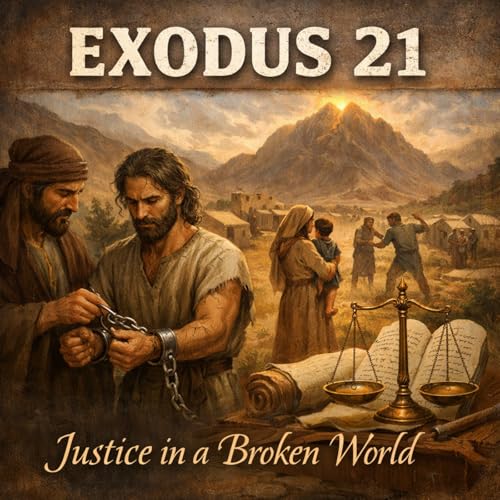
  • Exodus 21: Justice in a Broken World
    2026/03/29

    Slavery, justice, and God’s law—how do they fit together?

    In Exodus 21, we see God bringing order, restraint, and dignity into a broken world.

    This episode explores one of the most difficult passages in Scripture and reveals something surprising: God is not endorsing injustice—He is limiting it. In a culture where slavery, violence, and unchecked power were already the norm, God establishes boundaries that protect the vulnerable, restrain revenge, and affirm the value of human life.

    We walk through the laws of Exodus 21 and uncover how they functioned within their historical context. From the release of Hebrew servants after six years to the principle of “eye for eye,” these laws were not about creating a perfect society overnight—but about introducing justice where there was none.

    You’ll also hear how this passage connects to the broader story of the Bible. The same God who gives these laws is the One who delivers His people from slavery and ultimately points forward to something greater—freedom, restoration, and redemption through Christ.

    Jesus Himself sheds light on these kinds of laws in Gospel of Matthew 19, reminding us that some commands were given because of the hardness of human hearts. And yet, the trajectory of Scripture always moves toward freedom, dignity, and unity in Him.

    This episode will help you:

    Understand the cultural and historical context of Exodus 21

    See how God establishes justice within broken systems

    Recognize the difference between Biblical servitude and modern concepts of slavery

    Trace the thread of redemption from Exodus to Jesus

    If you’ve ever wrestled with difficult Old Testament laws, this conversation will challenge and encourage you to see the heart of God more clearly.

    👉 Share this episode with someone who struggles with passages like this, and join the conversation.

    👉 Follow for more daily Bible-based insights and practical teaching.

    👉 Keep reading—because even in the laws, God is revealing His character.

    Scripture References:

    Exodus 21:1–36

    Exodus 20:2

    Matthew 19:8

    John 8:36

    Galatians 3:28

    続きを読む 一部表示
    5 分
  • Exodus 20: The Law Written
    2026/03/29

    Ten commandments on the wall… but are they written on your heart?

    Exodus 20 reveals more than rules—it reveals the life God calls us to live.

    In this episode, we explore the foundation of God’s Law in Exodus 20 and the well-known Ten Commandments—words now appearing on posters in classrooms across Texas. But what do they really mean? And how do they fit into the larger story of Scripture?

    While many recognize the “top ten,” the Law of Moses actually includes 613 commandments (mitzvot), shaping every aspect of life for God’s people. The Ten Commandments serve as the foundation, revealing what it looks like to love God and love others in everyday life.

    But here’s the deeper truth:

    God gave the Law after He rescued His people—not before.

    “I am the Lord your God, who brought you out of Egypt…” (Exodus 20:2)

    The Law is not a ladder to earn salvation—it’s a path for those already redeemed.

    In this episode, we unpack:

    Why the Ten Commandments come first in the Law

    How the 613 commandments point to a complete life of obedience

    The danger of reducing God’s Word to something external—like a poster on a wall

    How Jesus Christ deepens the Law, moving it from outward behavior to inward transformation

    God’s ultimate desire: not just obedience, but hearts changed from within

    Jesus teaches that all the Law can be summed up in two commands: Love God. Love your neighbor. (Matthew 22:37–40)

    And the prophets point forward to something even greater: A day when God’s Law would not just be written on stone—but written on the heart.

    This episode invites you to reflect:

    Are these commands just something you see…

    or something you live?

    Because:

    If these words hang on a wall, they are easy to ignore.

    But if they are written on the heart, they become life.

    Keywords: Exodus 20, Ten Commandments, Law of Moses, 613 mitzvot, Bible teaching, Christian podcast, Jesus and the Law, heart transformation, Old Testament, faith and obedience

    Call to Action:

    If this episode challenged or encouraged you, share it with a friend, a student, or a teacher. Take a moment today to read Exodus 20 for yourself—and ask God not just to show you His Word, but to write it on your heart.

    Scripture References:

    Exodus 20:2–17

    Matthew 5:21–28

    Matthew 22:37–40

    Galatians 3:24

    Jeremiah 31:33

    続きを読む 一部表示
    6 分
  • Exodus 19: When Access Is Dangerous
    2026/03/28

    You were never meant to approach God casually… but you were always meant to come close.

    Exodus 19 reveals a holy boundary—and points to the only way it could ever be crossed.

    In this episode, we step into the trembling scene at Mount Sinai, where fire, smoke, and thunder surround the presence of God. The command is clear: do not come near. And yet, in the middle of that warning, God calls the priests to consecrate themselves.

    Why prepare to draw near… if you’re still not allowed to come all the way?

    Because Exodus 19 is not confusion—it’s a revelation.

    It shows us a God whose holiness is not casual, not safe, and not to be approached on human terms. There are layers of access: the people remain at a distance, the priests come nearer with preparation, and Moses alone ascends into the presence of God. This moment establishes a pattern we see throughout Scripture—distance, danger, and the need for a mediator.

    But this is not where the story ends.

    Sinai teaches us something we often forget: before we can understand grace, we must first understand holiness. Before we can appreciate access, we must feel the weight of separation. The boundaries at the mountain are not meant to push us away forever—they are meant to awaken us to our need.

    And that need is ultimately met in Jesus.

    What was once restricted becomes open. What was once dangerous becomes invitation—not because God has changed, but because a way has been made. The tearing of the temple veil marks a turning point in history: access to God is no longer limited to one man, one place, one moment.

    Through Christ, we are invited to draw near with confidence—but never casually.

    This episode challenges us to hold both truths together: God is holy beyond comprehension…

    and through Jesus, we are welcomed into His presence.

    So how do you approach God today?

    Do you keep your distance… or have you forgotten the weight of His holiness?

    Do you come casually… or confidently through the One who made a way?

    Take time today to reflect on the God of Sinai—and the Savior who brings you near.

    Call to Action:

    Read Exodus 19 slowly. Picture the scene. Feel the distance. Then read it again in light of Jesus—and respond. Draw near to God in reverence and confidence, trusting not in yourself, but in the One who stands between.

    Scriptures Referenced:

    Exodus 19:16–25

    Exodus 20:18–21

    Hebrews 12:18–24

    Matthew 27:50–51

    Hebrews 10:19–22

    続きを読む 一部表示
    5 分
  • Exodus 18: The Lord is Greater Than All Gods
    2026/03/25

    Before the Law was written, a foreign priest was already at the table.

    Exodus 18 reveals a God who is drawing people in long before they “belong.”

    In this episode, we explore one of the most overlooked and powerful moments in the book of Exodus—when Jethro, a Midianite priest, confesses the greatness of Yahweh and leads a sacrifice accepted by God. Even more surprising, Moses, Aaron, and the elders of Israel sit down to share a covenant meal with him before Sinai, before the Law, and before Israel is fully formed as a nation.

    This moment challenges how we think about who is “in” and who is “out.”

    Jethro hears the testimony of what God has done—and responds with worship:

    “Now I know that the Lord is greater than all gods.”

    Then he acts on that confession, offering sacrifices to Yahweh. There is no correction, no hesitation—only fellowship. A table is set, and a man from outside Israel is welcomed into the presence of God.

    But the story doesn’t stop at the table.

    Jethro also brings wisdom.

    Seeing Moses overwhelmed by the weight of leadership, he offers counsel: appoint capable, trustworthy men to share the burden. And Moses listens. Authority is distributed. The people are better served. And the wisdom comes from someone who, by every cultural measure, was an outsider.

    This is more than good leadership advice—it’s a glimpse into the heart of God.

    God is already at work beyond the boundaries we expect.

    Before Sinai…

    Before the commandments…

    Before the structure of Israel is complete…

    God is drawing people in.

    Jethro is not an exception—he is a preview.

    This passage invites us to ask:

    Where might God already be working that we haven’t recognized?

    Are we willing to receive truth and wisdom from unexpected places?

    And are we making room at the table for those God is drawing near?

    This episode reminds us that God’s mission has always been bigger than one people group. The story of Scripture moves outward—from Israel to the nations—and Exodus 18 gives us an early glimpse of that unfolding plan.

    Call to Action:

    Share this episode with someone who might feel like an outsider. Then take a moment to reflect—who has God placed in your life that you might be overlooking? Invite them in. There may already be a seat for them at the table.

    Scriptures Referenced:

    Exodus 18:8–12

    Exodus 18:17–23

    続きを読む 一部表示
    4 分
  • Exodus 17: Water from the Rock
    2026/03/25

    When the desert is dry and strength is gone, where does life come from?

    Exodus 17 reveals a surprising truth: God often brings provision and victory through human weakness.

    In this episode, we explore two powerful moments from Exodus 17 that reveal the same spiritual pattern. First, the Israelites face a desperate crisis in the wilderness—there is no water. Fear rises, complaints begin, and the people question why they ever left Egypt. But God responds in an unexpected way. He instructs Moses to strike a rock, and from that lifeless stone water pours out, sustaining the entire nation.

    This miracle becomes one of the most important symbols in Scripture. Later, the apostle Paul explains that the rock pointed forward to Christ, the true source of living water. Just as the rock had to be struck for water to flow, Jesus would be struck so that life could flow to the world.

    But the lesson of Exodus 17 doesn’t stop there.

    Soon after the water flows, Israel faces its first battle in the wilderness against the Amalekites. Joshua leads the fight in the valley while Moses stands on a hill with the staff of God raised in his hands. Something remarkable happens: whenever Moses’ hands are lifted, Israel prevails. When his arms grow tired and fall, the enemy advances.

    Eventually Moses’ strength fails. His arms grow heavy, and he cannot hold them up alone. So Aaron and Hur place a stone beneath him and stand beside him, supporting his arms until sunset. Through this shared weakness and dependence on God, Israel wins the battle.

    Both stories reveal the same surprising truth: God’s power is often revealed through human limitation. Water flows from a rock. Victory comes through a weary leader whose strength runs out. Again and again in Scripture, God chooses what appears weak so that His power becomes unmistakably clear.

    If you’ve ever felt spiritually dry, exhausted, or unable to carry the weight alone, Exodus 17 offers a powerful reminder. God still provides living water in the wilderness, and His strength is made perfect in weakness.

    Subscribe to the podcast and share this episode with someone who might need encouragement today. And wherever you are on your journey, keep seeking the One Story that leads to Jesus.

    Scripture References:

    Exodus 17:1–16

    Exodus 17:6

    Exodus 17:11–12

    1 Corinthians 10:4

    続きを読む 一部表示
    5 分
  • Exodus 16: Learning to Live on God's Provision
    2026/03/23

    What if the greatest miracle in the wilderness wasn’t the food—but the freedom to stop striving?

    In this episode, we explore how God used manna in the wilderness to teach His people a completely new way to live: a life built on trust instead of constant labor.

    In Book of Exodus 16, the Israelites leave Egypt only to face hunger in the wilderness. Fear quickly turns into grumbling as they remember the food they had in slavery. But instead of abandoning His people, God responds with mercy. Each morning He sends manna—bread from heaven—covering the ground like dew.

    Yet the miracle isn’t just the bread.

    God establishes a completely different system of provision. The people are instructed to gather only enough for each day. If they try to hoard it, the manna spoils overnight. Every sunrise becomes an invitation to trust God again.

    Then comes the most surprising part of the story: the Sabbath. On the sixth day, the people gather double because on the seventh day there will be none. That day is set apart as a day of rest.

    This is the heart of the lesson.

    In Egypt, survival depended on endless labor. Pharaoh’s system demanded constant productivity—more bricks, more work, more pressure. Rest didn’t exist for slaves.

    But God introduces a different rhythm for His people:

    work faithfully, gather what you need, and trust Him enough to rest.

    The manna teaches Israel—and us—that life does not ultimately depend on our ability to secure everything ourselves. God invites His people into a relationship where daily dependence replaces anxious striving.

    The wilderness becomes a classroom where God retrains a former slave nation to live in freedom.

    Later in Scripture, the meaning of manna grows even deeper. When Jesus Christ teaches His disciples to pray, He echoes the same lesson: “Give us this day our daily bread.” And in the Gospel of John, Jesus points back to the wilderness miracle and declares, “I am the bread of life.”

    The manna fed Israel for a day.

    Christ offers life that never runs out.

    Join us as we explore how Exodus 16 reveals God’s system of provision—a life marked by trust, daily dependence, and the freedom to rest in His care.

    If this episode encouraged you, consider sharing it with a friend, leaving a review, or subscribing so you can follow the journey as we continue walking through Scripture together.

    Keywords: Exodus 16, manna in the wilderness, daily bread, Sabbath rest, God’s provision, trusting God, Bible study podcast, wilderness journey, spiritual dependence, bread from heaven.

    Scriptures Referenced

    Exodus 16:1–35

    Deuteronomy 8:3

    Matthew 6:11

    John 6:32–35

    続きを読む 一部表示
    6 分
  • Exodus 15: From Singing to Grumbling
    2026/03/22

    They had just watched the Red Sea split and sang songs of victory. Three days later, the same people were grumbling in the wilderness.

    In Exodus 15 we see both the beauty of joyful worship and the fragility of human faith—and the unchanging faithfulness of God.

    After Israel’s miraculous deliverance from Egypt, Moses and the Israelites respond the only way a rescued people can: they sing. Exodus 15 records the first great song of redemption in the Bible. Moses leads the people in praising the Lord for defeating Pharaoh’s army and delivering them from slavery.

    “I will sing to the Lord, for He is highly exalted; He has thrown the horse and its rider into the sea.” (Exodus 15:1)

    Soon Miriam the prophetess joins in. With tambourine in hand, she leads the women in music and dancing as the whole community celebrates what God has done. Singing, music, and joyful movement become the natural expression of hearts that have witnessed the power of God.

    But the celebration does not last long.

    Only three days into their journey in the wilderness, the people cannot find drinkable water. When they finally reach water at Marah, it is bitter. The same voices that had just been singing now begin to complain.

    “The people grumbled to Moses, ‘What are we going to drink?’” (Exodus 15:24)

    Exodus 15 reveals how quickly human hearts can move from worship to worry, from praise to complaint. Yet the chapter also reveals the patience and mercy of God. Instead of abandoning His people, the Lord provides a solution. Through Moses, He turns the bitter water sweet and begins to teach Israel what it means to trust and obey Him.

    Here God reveals a powerful name: Yahweh Rapha — “The Lord who heals you.” The God who delivered Israel from Egypt is also the God who sustains and restores His people in the wilderness.

    The chapter closes with a beautiful picture of grace. After the bitterness of Marah, the people arrive at Elim—a place of abundance with twelve springs of water and seventy palm trees. Even though Israel’s faith was shallow, God’s faithfulness was not.

    Exodus 15 reminds us that while our faith may waver, the Lord continues to provide, guide, and heal. The same God who leads His people through the sea also leads them through the wilderness.

    If this episode encouraged you, share it with a friend, subscribe to the podcast, and continue reading through Scripture with us as we follow The One Story That Leads to Jesus.

    Scriptures Referenced:

    Exodus 15:1

    Exodus 15:20–21

    Exodus 15:24

    Exodus 15:26–27

    続きを読む 一部表示
    5 分